| 80 | DE PONTIBUS |
|
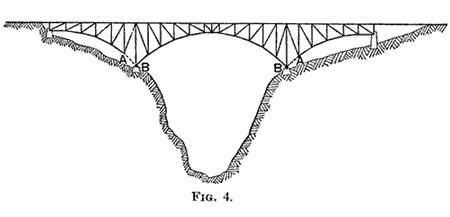
building vertically the two halves and lowering them by cables till they meet at the centre. Whichever of these methods is the easiest and cheapest is the one to adopt. A very easily erected arch is shown in Fig 4. The pieces marked AB are temporary, and are to be used only during erection. They can be made of timber, so as to be removed
readily after the arch is coupled at mid-span, or may be of steel, and be left in as idle members, solely for the sake of appearance. It will be seen from the diagram that the structure is a cantilever during erection, and afterwards consists of an arch span and two simple spans. This type of bridge probably requires a little more metal than would an ordinary segmental arch with trestle-approaches, and possibly is not quite as rigid as the latter, but the saving of cost in erection will fully offset these disadvantages. With three hinged arches there is no ambiguity whatsoever in the determination of stresses, but in all other cases there is. There are four cases all told, viz.: 1. Arch without any hinges. 2. Arch with one hinge (at crown). 3. Arch with two hinges (at abutments). 4. Arch with three hinges (at crown and abutments). These four cases can be reduced to three, because there is no good reason for ever building an arch fixed at the abutments and hinged at the crown. In Case No. 4 there are no temperature stresses, but in all of
|