| 64 | DE PONTIBUS |
|
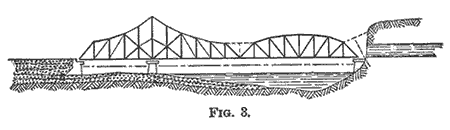
It is intended to erect the cantilevered portions of all three bridges with their ends higher than they will be in their final position, so that no raising, but only lowering, of the weight of the arms by the toggles will be necessary. The author is of the opinion that these toggles will work much more easily, and will prove in the end less costly, than the wedges used for adjustment in the erection of the Red Rock Cantilever Bridge, a description of which was given by Samuel M. Rowe, M. Am. Soc. C. E., in the Transactions of that Society for 1891. In one of the three true cantilever bridges for the proposed Japanese railroad an expedient has been adopted by the author which may be worthy of description. One approach to the structure, as shown in Fig. 3, is through a tunnel end-
ing in the face, of a vertical wall of rock. It was at first intended to use this rock in lieu of one anchor-arm of an ordinary cantilever by letting the main posts lie close to its vertical face and tying the top chords well back into its mass; but a study of the contours of the rock showed that it dipped off to one side of the line in such a way as to render such an anchorage of uncertain strength, so it was decided to increase the lengths of the suspended span and far cantilever-arm sufficiently to cut out the near cantilever-arm, and thus let the end of the suspended span roll on two small pedestals at the month of the tunnel. Five eighths of this span will be erected by toggles fastened into the rock, and the remaining three eighths will be cantilevered out also by toggles from the end of the far cantilever-arm. This method requires more metal than does the one first contemplated; nevertheless it is the cheapest, everything considered, that can be adopted. The rock-anchorage is amply strong for the dead-load pulls
|